
Democracy Vista
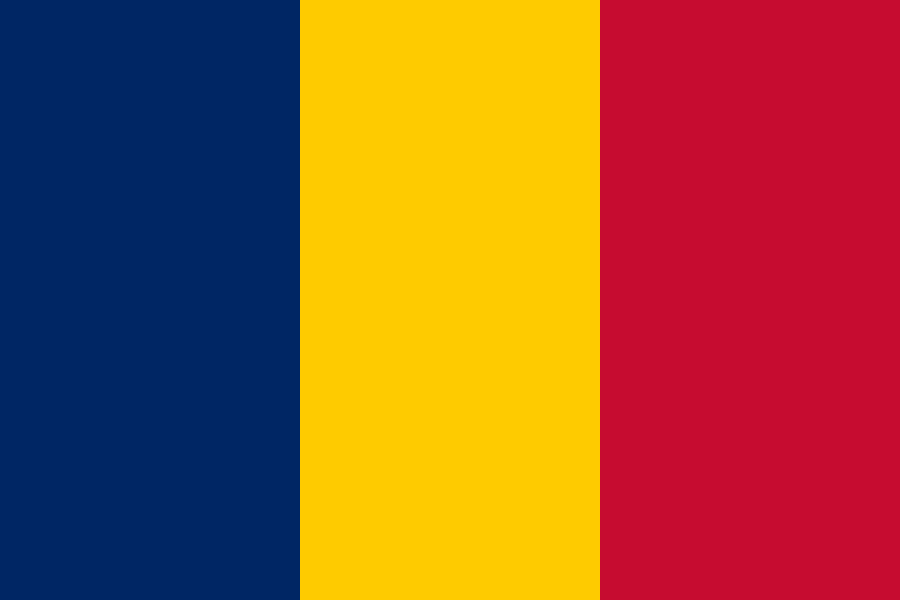
Official national flag of Chad. Democracy Vista assessment territory.
Official Territory

Chad

Republic of Chad

Pop: 19,340,757
Zone: Africa
DEMOVISTA PROPRIETARY // 2026

Liberty
Analysis

A weighted composite metric synthesizing global data on democracy, human rights, economic freedom, and societal development.

3.3INDEX / 10.0
Authoritarian Regime

Supporting
Indices

4.4
SCORE / 10

Democracy Quality

Comprehensive analysis of democratic institutional quality

Hybrid Regime
4.5
SCORE / 10

Economic Freedom

Degree to which policies and institutions support economic liberty

Hybrid Regime
4.6
SCORE / 10

Human Freedom

A comprehensive measure of personal, civil, and economic freedom

Hybrid Regime
5.6
SCORE / 10

Economic Policy

Analysis of rule of law, government size, and regulatory efficiency

Hybrid Regime
2.6
SCORE / 10

Liberal Democracy

Accountability to citizens through elections and individual rights protection

Authoritarian Regime

Structural
Categories

#136
🗣️

Freedom of Speech

3.3

Severe restrictions on public expression and suppressed media.

Status
#136/ 184
#153
📜

Rule of Law

3.3

Weak rule of law with pervasive legal irregularities.

Status
#153/ 184
#137
👩

Women's Freedom

3.6

Severe restrictions on women's autonomy and legal standing.

Status
#137/ 184
#128
👥

Minorities Freedom

3.8

Systemic discrimination and severe marginalization of minorities.

Status
#128/ 184
#149
🛡️

Crime & Safety

3.3

High violent crime rates and compromised safety infrastructure.

Status
#149/ 184
#143
🗽

Individual Liberties

3.3

Severe constraints on personal autonomy and identity expression.

Status
#143/ 184
#134
🗳️

Democratic Health

2.7

Severe democratic deficits or authoritarian structures.

Status
#134/ 184
#162
🏛️

Institutional Integrity

1.9

Pervasive corruption and lack of government integrity.

Status
#162/ 184
#147
⚖️

Civil Justice

4.3

Compromised legal integrity with systemic political interference.

Status
#147/ 184
#156
📈

Economic Vigor

3.9

Stagnant or highly suppressed economic capacity.

Status
#156/ 184
#162
🏦

Macroeconomic Stability

4.0

Severe currency instability and massive inflation risks.

Status
#162/ 184
#161
🌐

Market Openness

3.7

Closed market with severe barriers to external trade.

Status
#161/ 184
#148
📋

Regulatory Environment

3.7

Hostile regulatory environment stifling operational freedom.

Status
#148/ 184
#154
🌟

Quality of Life

3.8

Critical lack of basic human development infrastructure.

Status
#154/ 184
#144
🌈

Social Tolerance

3.0

Systemic marginalization and lack of minority protections.

Status
#144/ 184
#132
📰

Expression and Information

3.2

High systemic censorship and severe restrictions on expression.

Status
#132/ 184
#135
🤝

Civil Society

3.4

Strict suppression of non-governmental associations.

Status
#135/ 184

Metadata &
Technical Details

Basic Information

Capital

N'Djamena

Region

Africa

Subregion

Middle Africa

Landlocked

Yes

Culture & Language

Languages

Arabic, French

Currencies

Central African CFA franc (Fr)

Technical Details

Country Codes

TDTCD

Neighboring Countries

CMR, CAF, LBY, NER, NGA, SDN

Geographic
Hub

Initializing Projections...
Geospatial Context
Coordinates15.00°N, 19.00°E
ProjectionEquirectangular

National
Insights

Background

Chad emerged from a collection of powerful states that controlled the Sahelian belt starting around the 9th century. These states focused on controlling trans-Saharan trade routes and profited mostly from the slave trade. The Kanem-Bornu Empire, centered around the Lake Chad Basin, existed between the 9th and 19th centuries, and at its peak, the empire controlled territory stretching from southern Chad to southern Libya and included portions of modern-day Algeria, Cameroon, Niger, Nigeria, and Sudan. The Sudanese warlord Rabih AZ-ZUBAYR used an army comprised largely of slaves to conquer the Kanem-Bornu Empire in the late 19th century. In southeastern Chad, the Bagirmi and Ouaddai (Wadai) kingdoms emerged in the 15th and 16th centuries and lasted until the arrival of the French in the 19th and 20th centuries. France began moving into the region in the late 1880s and defeated the Bagirmi kingdom in 1897, Rabih AZ-ZUBAYR in 1900, and the Ouddai kingdom in 1909. In the arid regions of northern Chad and southern Libya, an Islamic order called the Sanusiyya (Sanusi) relied heavily on the trans-Saharan slave trade and had upwards of 3 million followers by the 1880s. The French defeated the Sanusiyya in 1910 after years of intermittent war. By 1910, France had incorporated the northern arid region, the Lake Chad Basin, and southeastern Chad into French Equatorial Africa.  

Chad achieved its independence in 1960 and then saw three decades of instability, oppressive rule, civil war, and a Libyan invasion. With the help of the French military and several African countries, Chadian leaders expelled Libyan forces during the 1987 "Toyota War," so named for the use of Toyota pickup trucks as fighting vehicles. In 1990, Chadian general Idriss DEBY led a rebellion against President Hissene HABRE. Under DEBY, Chad approved a constitution and held elections in 1996. Shortly after DEBY was killed during a rebel incursion in 2021, a group of military officials -- led by DEBY’s son, Mahamat Idriss DEBY -- took control of the government. The military officials dismissed the National Assembly, suspended the Constitution, and formed a Transitional Military Council (TMC), while pledging to hold democratic elections by October 2022. A national dialogue in August-October 2022 culminated in decisions to extend the transition for up to two years, dissolve the TMC, and appoint Mahamat DEBY as Transitional President; the transitional authorities held a constitutional referendum in December 2023 and claimed 86 percent of votes were in favor of the new constitution. The transitional authorities have announced plans to hold elections by October 2024.

Chad has faced widespread poverty, an economy severely weakened by volatile international oil prices, terrorist-led insurgencies in the Lake Chad Basin, and several waves of rebellions in northern and eastern Chad. In 2015, the government imposed a state of emergency in the Lake Chad Basin following multiple attacks by the terrorist group Boko Haram, now known as ISIS-West Africa. The same year, Boko Haram conducted bombings in N'Djamena. In 2019, the Chadian government also declared a state of emergency in the Sila and Ouaddai regions bordering Sudan and in the Tibesti region bordering Niger, where rival ethnic groups are still fighting. The army has suffered heavy losses to Islamic terror groups in the Lake Chad Basin.