
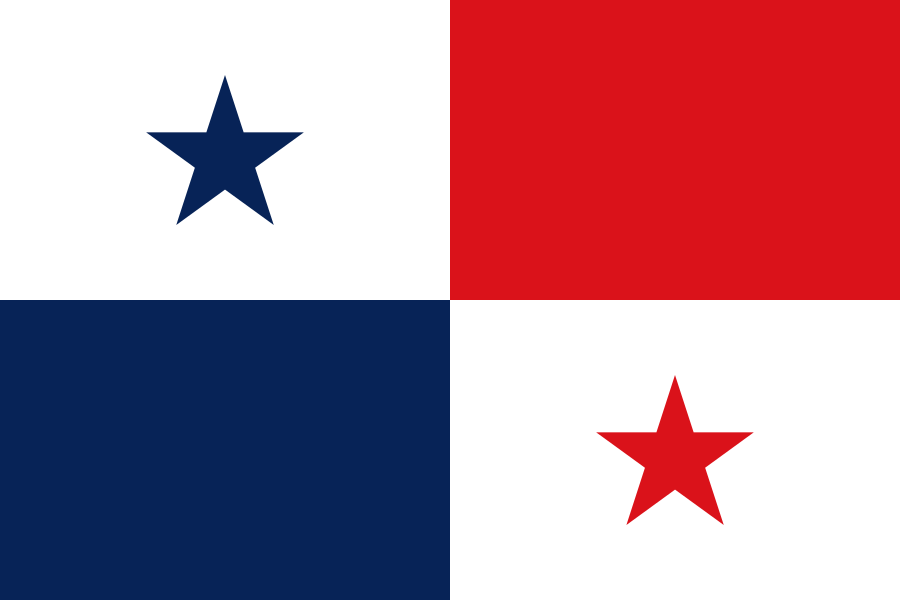
Panama
Republic of Panama
Liberty
Analysis
A weighted composite metric synthesizing global data on democracy, human rights, economic freedom, and societal development.
Supporting
Indices
Democracy Quality
Comprehensive analysis of democratic institutional quality
Economic Freedom
Degree to which policies and institutions support economic liberty
Human Freedom
A comprehensive measure of personal, civil, and economic freedom
Economic Policy
Analysis of rule of law, government size, and regulatory efficiency
Liberal Democracy
Accountability to citizens through elections and individual rights protection
Life Motives
Assessment
Investment & Business
Exercise standard caution; moderate risks exist in fiscal policies or property frameworks.
Living & Comfort
Livable environment but moderate concerns regarding local day-to-day security and crime rates.
Career & Labor
Average labor conditions; some friction exists in market regulations or structural labor freedom.
Digital Nomad
Viable for remote work but expect friction regarding foreign visitation limits or minor censorship.
Education & Study
Acceptable for study but bounded by moderate restrictions on academic or cultural expression.
Safety & Inclusion
Moderate equality protections; some demographic groups may face structural or cultural headwinds.
Advocacy & Expression
Possible to advocate, but activists may encounter soft censorship or media control resistance.
Stability & Justice
Moderate institutional resilience; the judicial branch may be vulnerable to occasional interference.
Structural
Categories
Freedom of Speech
Moderate constraints; expression permitted but with some friction.
Rule of Law
Functional legal systems with occasional inconsistency.
Women's Freedom
Strong legal and structural protections for women's rights.
Minorities Freedom
Strong protections for ethnic, religious, and sexual minorities.
Crime & Safety
Low violent crime rates and robust personal security infrastructure.
Individual Liberties
Strong freedoms in movement, relationships, and personal identity.
Democratic Health
Functional but flawed democratic processes.
Institutional Integrity
Moderate systemic corruption or institutional friction.
Civil Justice
Impartial court system with strong political independence.
Economic Vigor
Developing market with average structural freedom.
Macroeconomic Stability
Reliable local currency strongly protected from inflation.
Market Openness
Highly fluid cross-border trade and financial liberties.
Regulatory Environment
Bureaucratic friction impedes rapid business operations.
Quality of Life
Moderate welfare capacity; localized safety risks exist.
Social Tolerance
Robust mechanical protections for societal minorities.
Expression and Information
Open information flow with strong protections against censorship.
Civil Society
Free environment for forming independent unions or parties.
Metadata &
Technical Details
Basic Information
Capital
Panama City
Region
Americas
Subregion
Central America
Landlocked
No
Culture & Language
Languages
Spanish
Currencies
Panamanian balboa (B/.), United States dollar ($)
Technical Details
Country Codes
PA • PAN
Neighboring Countries
COL, CRI